


The production descriptions here are Sam's account of his practice. Product details specify the dimensions, materials and frame offered for an individual piece. A numbered edition's total run is different from the number still available to buy.


Four works. Finite series. Individually numbered and hand-signed by Sam.
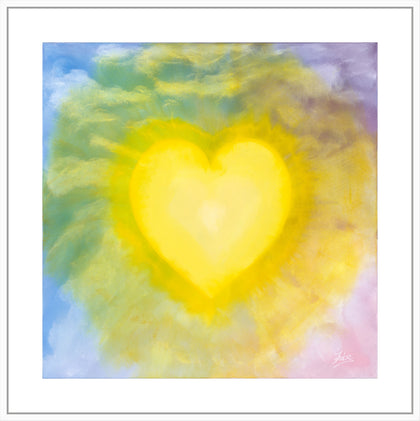
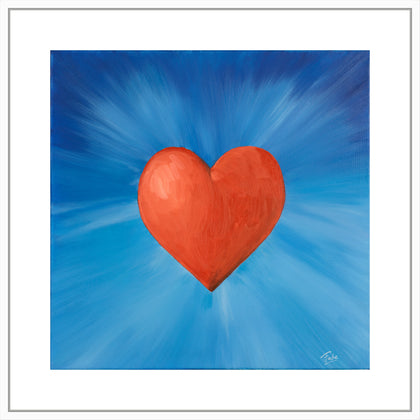
A colourful way into Sam’s art, for a focal point at home or a gift chosen with care.
Fine-art prints, made to order with no fixed edition limit.
Browse open editions

I build frames by hand in my workshop, either painted by commission or made from premium woods like oak, walnut, or maple. Each frame is made to size, on demand, for the work it needs to hold.
Read Sam's story
Life Art brings Sam's visual language into the objects that move through a day: pieces you wear, carry, keep close, or use at home. It is art entering daily rituals with intention, made for people who want beauty to be present beyond the wall.
Buying your first piece of art? This guide explains what you receive when you choose an original, a limited edition or an open edition, and why their prices differ. Heartflare appears throughout so you can compare the same image as three different physical objects.
| What you are comparing | Original | Limited edition | Open edition |
|---|---|---|---|
| The object you receive | The painting Sam worked on by hand | A reproduction from a fixed print run | A reproduction without a fixed run limit |
| Scarcity | One unique physical painting | A total run size fixed in advance | No numbered scarcity cap |
| Surface and detail | The actual painted surface and its texture | Fine reproduction of the image on premium archival paper | A more affordable reproduction with less fine detail visible close up |
| Production | Sam's physical work on the original | Sam's described 11-ink printing process and premium framing | A standard printing process, good paper and more affordable framing |
| Numbering | One unique object | Individually numbered; for example 12/50 | No numbered run limit |
| Price drivers | The unique physical work, materials and Sam's pricing method | Production materials, framing and the fixed edition size | Lower production costs and no fixed edition cap |
| What might matter to you | Owning the actual painting | Fine print production and a place within a fixed run | Enjoying the image at a more accessible price |
The production descriptions here are Sam's account of his practice. Product details specify the dimensions, materials and frame offered for an individual piece. A numbered edition's total run is different from the number still available to buy.
The original, limited edition and open edition all carry Heartflare's yellow heart and surrounding color. The photograph shows the relationship between them; the individual views below let you look more closely at what changes in the object itself.
When people start buying art, the word "edition" trips up almost everyone at some point. You see a piece you love, and then you notice there's a number next to it, like 12/50, or a little phrase that says "open edition," or nothing at all. What does that actually mean for what you're buying, and why does it change the price so much? I get this question all the time, so let's unpack it properly.
At the root of it, there are really three categories: originals, limited editions, and open editions. Each one answers a different question about scarcity, and scarcity is a big part of what gives a piece of art its value, alongside the more obvious stuff like how much I love making it and how much skill went into it.
An original is the one and only. There is no copy of it, there will never be a copy of it, and once it's sold, that's it, I don't have it anymore and neither does anyone else. When you buy an original piece of mine, you're not just buying an image, you're buying the actual object I physically worked on, with the brushstrokes, the texture, the slightly uneven edges where my hand wasn't perfectly steady. It carries all my hesitations and all my decisions in real time, which is a strange thing to think about when you look closely at a painting. This is, naturally, the most expensive category, because the scarcity here is absolute. Nobody else in the world can own this exact piece.
View Heartflare OriginalThis is where reproductions come in, but with a hard ceiling. I decide ahead of time that only a certain number of prints of a given piece will ever exist, say 50, and then I produce exactly that many and not one more. Each print is numbered, like 12/50, which tells you it's the twelfth print out of a total run of fifty. Once those fifty are sold, that's it, there is no 51/50 coming later no matter how much anyone asks me. I typically sign and number each one by hand, which takes a while when you're doing fifty of them, but it matters, because that signature is part of what makes the scarcity real and verifiable. The lower the total run, the closer it is in spirit to an original, and the price reflects that. A limited edition of 10 behaves very differently in the market than a limited edition of 500, even if it's the exact same image.
View Heartflare Limited EditionThese are prints with no cap on how many will ever be made. If demand is there, I keep printing them. This is the most accessible way to own a piece of my work, both in terms of availability and price, because there is no artificial scarcity baked into the price. It's a great entry point if you love an image but aren't in a position, or simply don't feel the need, to own something one-of-a-kind or part of a tightly capped run. These use a more standard print process and paper, and a more affordable frame, rather than the premium materials that go into a limited edition, which is part of how I keep the price accessible. What doesn't change is the attention I put into the image itself, the color accuracy and the care in getting it right, that part isn't scaled down.
View Heartflare Open EditionThere is a production tradeoff. The original has the physical surface Sam painted. The Limited Edition reproduces the image with finer detail, while the Open Edition uses a less expensive production process. These close-ups show that difference without smoothing or sharpening it away.
At the scale of the whole piece, the yellow heart, surrounding color and overall feel carry across all three. Understanding both views helps you decide how much the surface, fine reproduction and materials matter to you.
These are photographs of the corresponding area, not a laboratory comparison at identical magnification. You can open each genuine detail image to inspect it at its supplied resolution.
In the example 12/50, 12 identifies an individual print within a run whose total size is 50. It does not mean that 12 copies remain, that 50 are in stock, or that the print was the twelfth one sold. The total run stays fixed; the number available changes as prints sell.
This is an explanatory example, not the edition size of Heartflare.
So how do I actually implement this in practice at Hearts & Colors?
Every piece I create starts its life as an original. That decision, whether it ever becomes a limited or open edition print, happens afterward, and it's not automatic. Some pieces I keep as originals only, because I feel the piece needs to stay singular, or because the physical texture and medium genuinely don't translate well to print. Others I think work beautifully as editions, usually the ones with strong graphic clarity, bold color blocking, or a composition that holds up at different scales.
When I do decide to make a limited edition, the number I choose for the run isn't random. I think about the piece itself, how it fits with my chosen complexity and quality dials I use for pricing, and how I want the eventual value curve for collectors to behave over time. A smaller run protects long-term value better. A larger run makes the piece reachable to more people. There's a tension there and I sit with it before locking in a number, because once I commit to a run size, I don't go back on it. That commitment is the entire point, if I started quietly printing more after the fact, I'd be lying to everyone who bought in early trusting the number on their print.
Each numbered print gets tracked individually on my end, same spirit as the Excel sheet I use for pricing, so I always know exactly how many of a given edition have sold and how many remain. When a limited edition sells out, it's marked as sold out everywhere, and it stays that way.
Open editions I treat more like my accessible, ongoing catalog, and the production behind them is deliberately different, not just the scarcity model. Limited editions are printed using an 11-ink process on a premium archival paper, the kind of print quality that holds color and detail the way a serious print collector expects, and each one is framed in a frame that runs me about 200 euros on its own. That's part of why limited editions carry the price they do, it's not only the numbered scarcity, it's genuinely a more expensive object to produce. Open editions use a good, solid paper, but a much more standard run of the mill print process, and they come in a more affordable frame, because I want the entry price to stay within reach for a much wider audience. The craftsmanship of the image is the same, I'm not cutting corners on the art itself, but the physical print and frame are a real step down in cost and quality to make that accessibility possible. A lot of collectors who start with an open edition print end up coming back years later for an original, or for a limited edition, once they've gotten to know the work, and I love that arc.
If the physical painting and its one-of-a-kind surface are what you want to own, look at the original. If fine print production and a fixed run matter to you, consider a Limited Edition. If you want the image in your home at a more accessible price, an Open Edition may suit you.
If you're buying your first piece of art and trying to decide between these, my honest advice is this: buy what moves you, not what you think will appreciate the most. Scarcity affects price and, over time, potential value, but it doesn't determine whether a piece deserves to be on your wall. An open edition print you look at every single day and genuinely love is a better purchase than a limited edition you bought purely as an instrument and never really connected with.
And as always, if any of this is unclear or you think I'm handling editions the wrong way, tell me. I'm figuring this out in public, piece by piece, same as everything else.
Find a piece that moves you.
Yes. The original is the unique physical painting. An edition reproduces its image as a separate object. Owning a print does not mean owning the physical painting, and producing a print does not create a second original painting.
No. Sam decides afterward whether an original will become an edition. Some remain available only as originals.
No. It means there is no fixed total run limit. Current availability, sizes and options still depend on the particular product.
No. Production, paper, framing and the physical surface also differ. The full photographs show the overall image, and the genuine close-ups show differences in reproduction detail.
A fixed edition size is a commitment about the number of prints, not a guarantee of future resale value. Sam's advice is to buy the work you connect with.
No. Read the specifications for the particular piece and option you are considering. The comparison photographs show Sam's Heartflare examples; they do not establish a universal size or frame for every edition.