


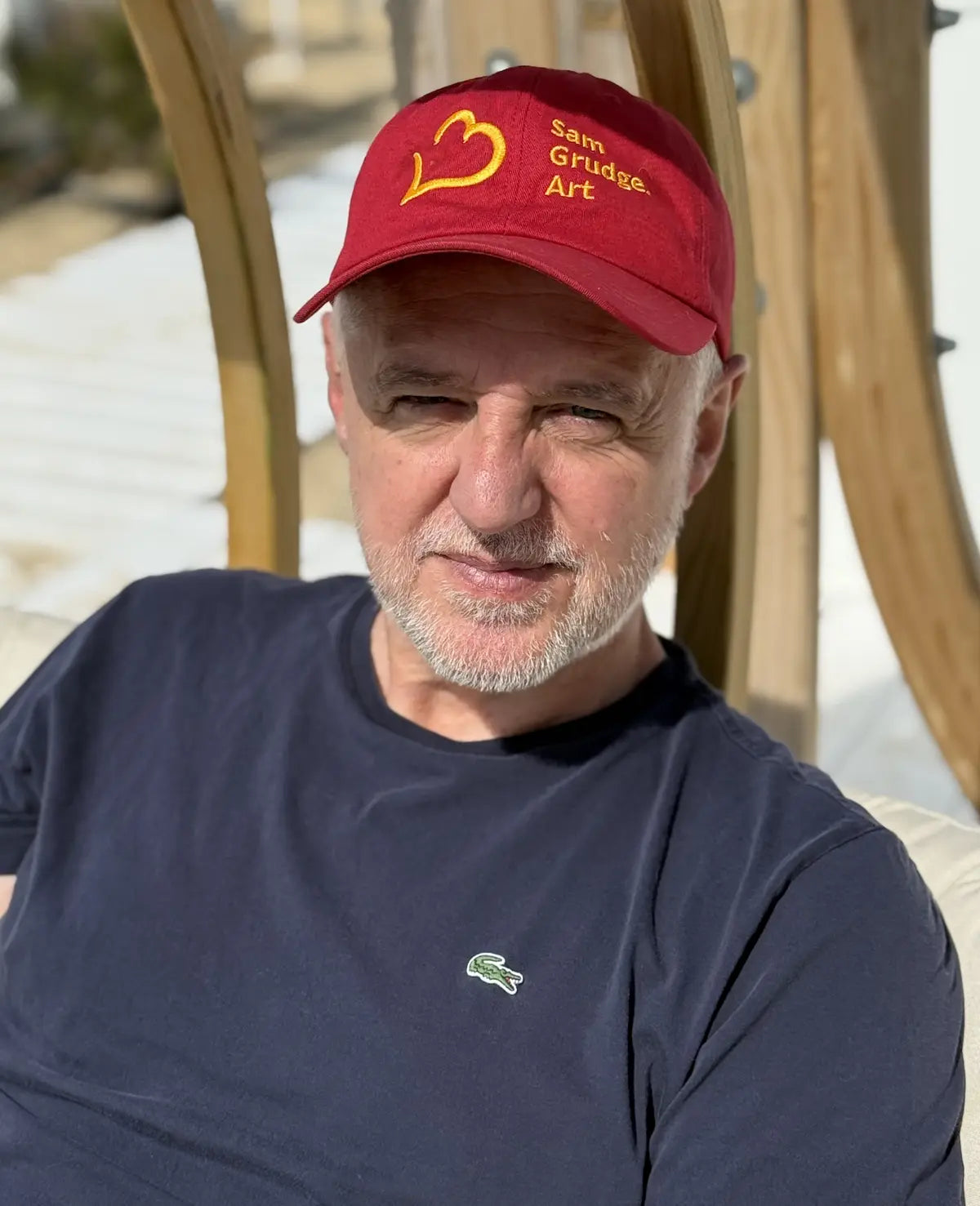
The Story of Sam Grudge
I almost didn't get to tell this story.
At 47, I had a heart attack — the kind they call a widow maker, because half the people it happens to don't make it to the hospital. It was January 2018. I was living in Florida with my wife and two daughters, and at 5:30 in the morning my chihuahua, Peanut, climbed onto my chest and would not stop whining until I woke up. My heart was already slowing down. I felt the pain and didn't understand it, and when it wouldn't pass I told my wife to get in the car. We lived five minutes from the hospital. We ran every red light. I walked into the ER and collapsed on the floor, and a team came through the doors and saved my life. A small dog is the only reason I was awake to feel anything at all.
Surviving the heart attack was the easy part. The harder truth was underneath it: I had been struggling for a long time, and I was about to struggle much more.
The way down
What survival did not fix.
Later that year we moved to Atlanta, where I took on the lead of a new Accenture innovation studio we built at Georgia Tech. It was a real challenge and, honestly, a way to stop living out of a suitcase. But my marriage was failing and my anxiety and depression were quietly winning. I fought it for two years and kept losing. By 2020 there were whole days I spent lying on the floor of my office, unable to do much else.
In January 2021 — almost three years to the day after my heart attack — I left. I left my marriage, I left my family, and I left the country I love, putting an ocean between my old life and whatever was next. I went to Belgium, where my parents were, because my mother was gravely ill and I wanted to be near her. The divorce followed soon after. I went back to Atlanta once — to pick up Peanut. She's resting next to my desk as I write this.
I told myself I was moving toward healing. I was actually walking into the deepest part of the dark. Over the next stretch I lost my grandmother, then my mother, then the uncle I loved most, then his wife, then my mother's sister — one after another, faster than grief can be metabolized.
The decision to live
One foot in front of the other.
It took me another year to decide I wanted to live. I want to be honest about how that happened, because it wasn't the way people imagine it. It was not instinct. I had to sit down and reason my way to it — an actual list of pros and cons — and choose the deliberate answer over the one that felt closer at hand. And then, true to how I'm built, I made a plan. If I was going to stay, I would lead a life I could be proud of. Not to please anyone else. To learn to value my time here, and to make it count.
That's when I took real stock of my mind and my body and surrounded myself with a team of doctors, for both. Beatrice stood with me through every step of it and helped me find my feet again. Somewhere in that long climb I ran my first 5k in years. Five kilometers isn't much. But I had learned to put one foot in front of the other, and that turned out to be everything. I mean to run a marathon again.
Time doesn't really heal anything. What it does is give you another day — and let the world keep turning, until the stars shift and maybe you feel different too. That belief is the floor I rebuilt my life on. It's also why, when I started a campaign to help others stay, I called it One More Day.
Why I paint
Color is the screaming part.
Painting found me in the middle of that climb, and it changed my life a second time.
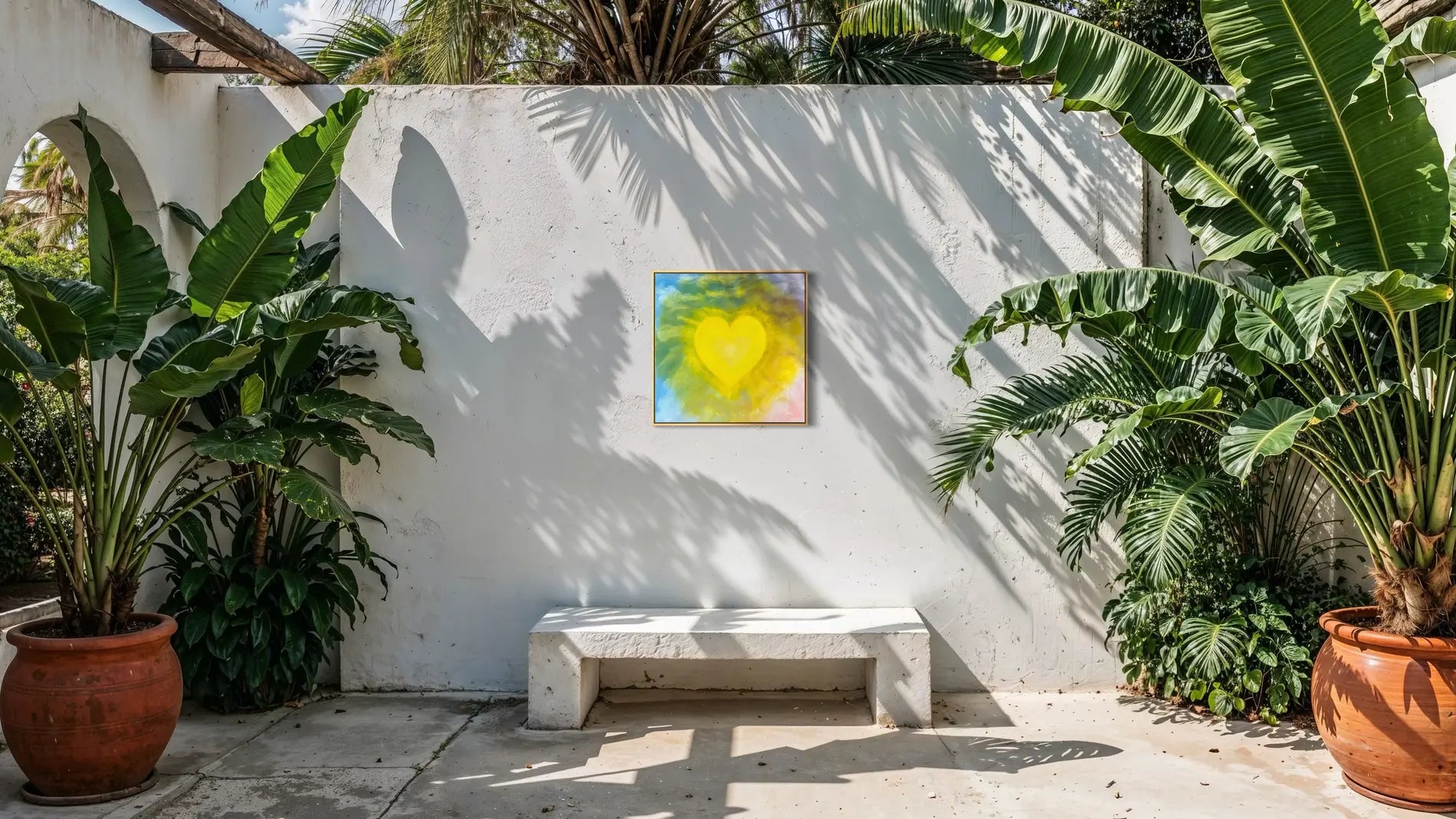
I don't paint sadness. There's already too much of that in the real world. What I chase on the canvas is the opposite — that scream you feel growing inside when you're overwhelmed with love and happiness. I work in bold, vivid color because color is the screaming part. The hearts are the simple, universal thing everyone recognizes: connection, hope, the plain human signal of I see you, I feel you.
My mother filled her home with hearts. She was, above everything, about love — forgiveness, kindness, the beauty of life's simplest pleasures. When I began to paint, the heart came naturally. But it was unmistakably hers.
I paint to share that feeling, and to hope it spreads — that if enough people carry these images home, we might all start to like each other a little more.
I want to paint the world over with hearts.
The work
Feeling, made visible.
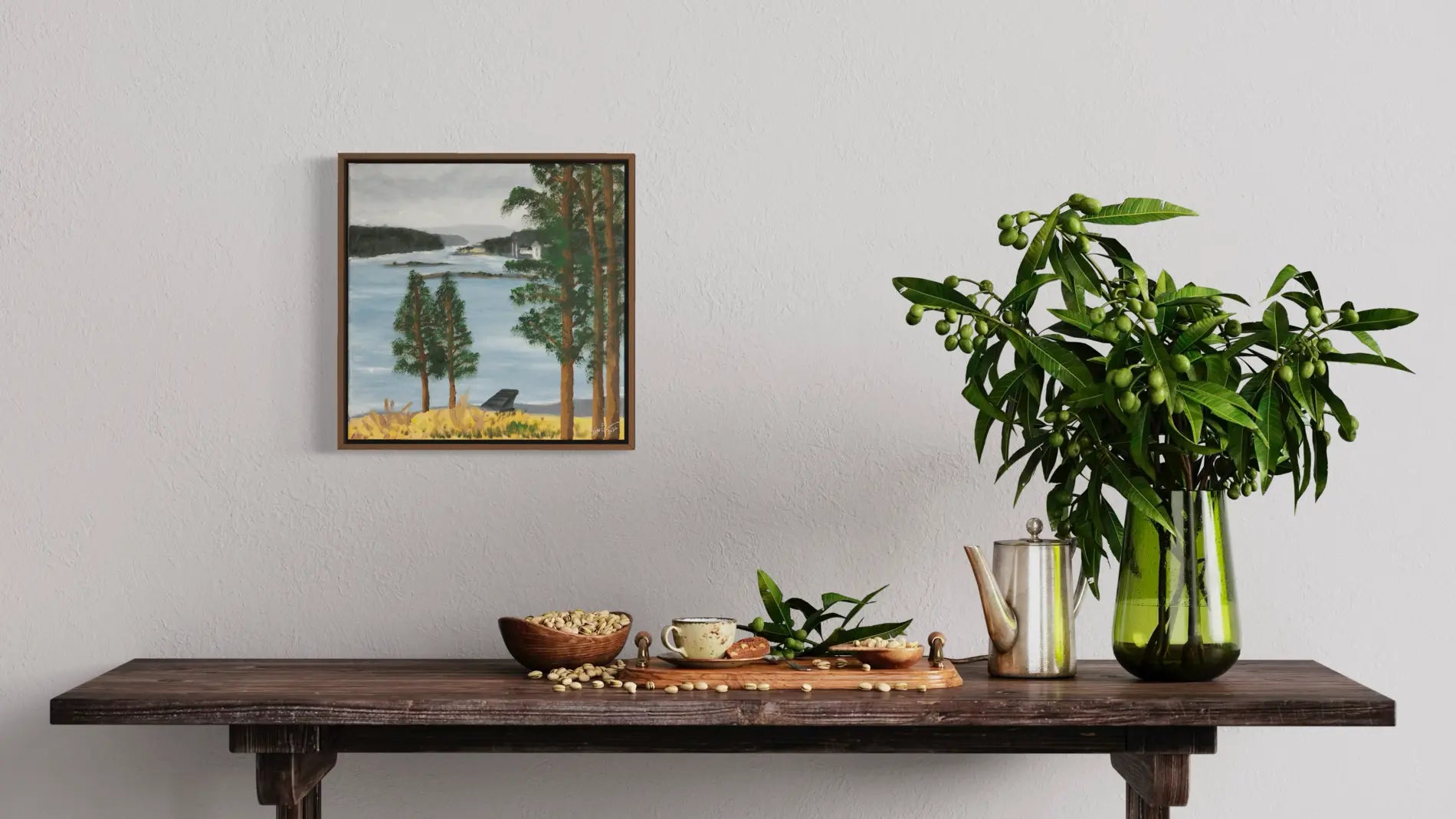
Stand in front of a Sam Grudge painting and you know it on sight: bold, saturated color turned all the way up, and a heart. Almost every canvas is a heart. But not always the obvious way — some hide their hearts in plain sight. Nesøya, a small seascape from a Norwegian fjord where Sam stayed, holds five of them; one is so quiet, up in the sky, you could look for a long time and never find it. Consider that a secret between you and the painting.
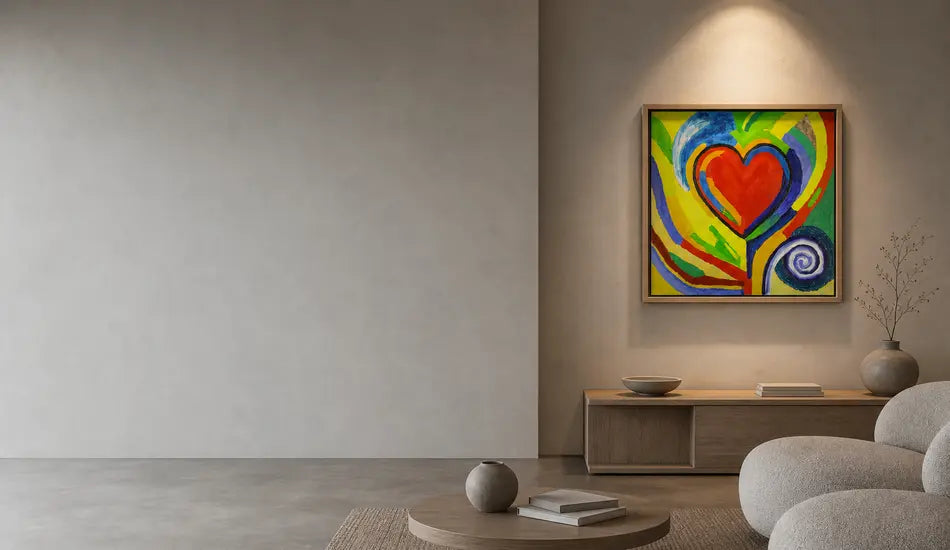
The language is pop art, but it doesn't stop there. It reaches into abstraction and abstract expressionism, with a thread of Symbolism running underneath — the heart standing in for connection, hope, and the plain human signal of I see you. Sam isn't precious about which tradition a piece belongs to. He paints what the feeling needs.
He works primarily in oil, sometimes in acrylic, and refuses to limit himself to one tool or one gesture. He owns more than 120 brushes — "because I can't make up my mind, and I want to do it all" — and loves the palette knife as much as any of them. There is nothing in painting that doesn't interest him to explore. That restlessness lives on the surface of the work: thick, alive paint, texture you want to touch, passages of gold where two things become greater than the sum of their parts.
The color is the loud part — the scream of love and happiness made visible. In a world quietly draining to grey, painting it this brightly is the whole point.
Less grey, on purpose
I walked the other way.
The world has gone grey, and not as a metaphor. Most of our cars, our objects, our walls have quietly drained to black, white, and beige — one safe choice at a time, nobody quite deciding it, everybody going along. I think we traded feeling for safety and let the world go quiet.
I walked the other way. I spent more than thirty years building things in the most carefully designed corners of the world — a creative engineer, inventor, and executive who worked alongside organizations like LEGO, Disney, and Blizzard/Activision. I watched neutrality get sold as sophistication, and I didn't believe it. So I went into a studio, into oil and acrylic and a red pair of coveralls, and I started putting the color back.
That's where I plant my flag. Hearts that are too red, skies that are too blue, bursts of orange and yellow that don't ask permission.
The honesty
That's just what ducks look like.
I lead, I create, and I struggle — sometimes all at once. I used to think that made me an ugly duck. It turns out that's just what ducks look like. The more openly I've talked about my own state, the more people around me have opened up about theirs, and the less alone any of us has felt.
Struggling isn't poor performance. It's performance under undue pressure. There is something inside each of us begging to be let out to shine — often buried under scars and low self-esteem. I'd rather spend my life helping let it out than pretending the scars aren't there.
The less we pretend the scars aren't there, the less alone any of us has to feel.
The workshop
Before brushes, there was wood.
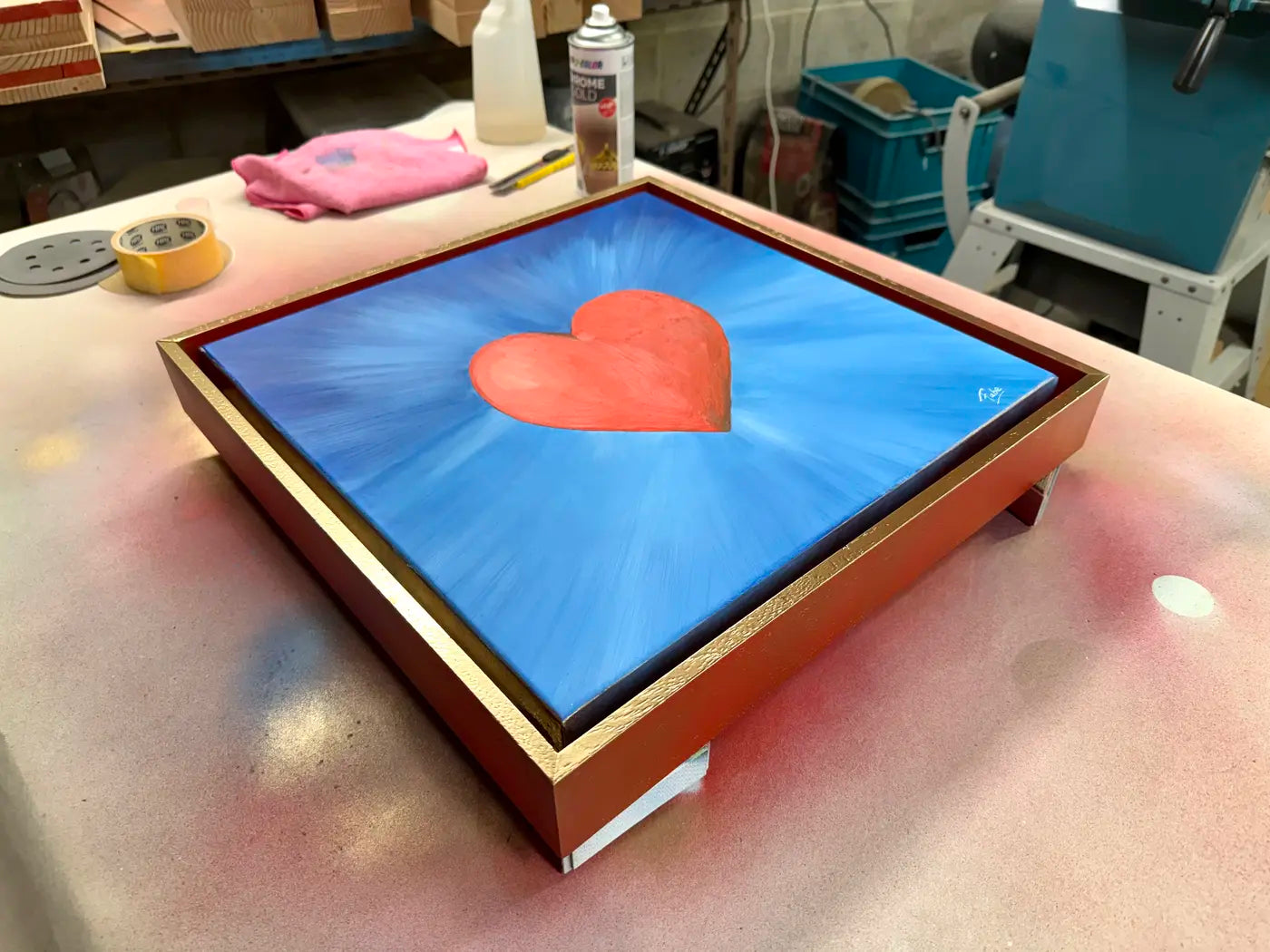
Before brushes, there was wood. Woodworking was my first creative outlet, and it's still part of me. Wood has its own will — grain, knots, resistance — and you don't command it, you collaborate with it. I hand-craft the frames for my paintings in oak, walnut, and maple, often adding other species for contrast. For me, a painting isn't finished until the frame is part of the story. Even the crate I ship in is built by hand, with heart-shaped corners — because it wouldn't be mine otherwise.
What I'm building
Something bigger than me.
I sign my work Sam Grudge now — the evolution of an identity built across a lifetime of making things. I once signed as Fabe, a nod to the child within. Both are true.
My mission is simple, and bigger than me: cover the world in hearts, and build spaces where people can live with less anxiety, less stress, and more humanity. It's why I make the work, and why I started One More Day — to turn it into something that helps people stay: a stand for mental health, for suicide prevention, and for the quiet, defiant act of choosing color in a world that gave it up.
The need is staggering and it is quiet. Five people a day in Belgium alone. Around the world, one every forty seconds — each one hidden behind a routine that looked fine from the outside. I was almost one of them. That's why I won't be quiet about it.
If you believe art can heal, connect, and empower, you're welcome here.
Come stand in the color with me.
— Sam
Continue the story
Find the heart that stays with you.
References
- World Health Organization, "Suicide" (fact sheet): "more than 720,000 people die due to suicide every year" (727,000; 2021 data). https://www.who.int/news-room/fact-sheets/detail/suicide
- Sam Grudge, "One More Day" (Hearts & Colors), citing Belgium suicide figures (~5/day). Belgian prevention resource: Centre de Prévention du Suicide / Zelfmoord1813. https://www.zelfmoord1813.be/en