



Sam's Blog
Less Grey. On Purpose.
June 13, 2026
Look around you. Really look.
The car in your driveway is probably black, white, silver, or grey. So is your neighbor's. So is almost every car on the road — and that isn't a feeling, it's a fact. Twenty years ago, around six in ten new cars were sold in some shade of greyscale. Today it's eight in ten. We had the whole spectrum available to us and we quietly agreed, almost without discussing it, to drive around in the colors of wet pavement.
It isn't just cars. A few years ago, researchers at the Science Museum in the UK pulled roughly seven thousand everyday objects out of their collection — things made between 1800 and today — and laid them out across time. The pattern was undeniable. Decade by decade, our stuff got greyer. The reds, the greens, the deep blues, the warm ochres that filled the world for most of human history slowly drained away until, somewhere in the last century, grey won. Today, most of the manufactured objects around you — the estimates land around sixty percent — are black, white, or grey.
And then there are our homes. Walk through any new development, scroll through any interiors feed. White walls. Greige walls. “Warm” grey, “soft” grey, “agreeable” grey — a hundred names for the same fear. We have turned our own homes, the one place that is supposed to be entirely ours, into showrooms for the absence of color.
I want to ask the question nobody seems to want to ask out loud: what are we so afraid of?
Because that's what it is. Fear. We've been taught that grey is safe, that beige is tasteful, that color is loud and childish and risky. Resale value. Timelessness. Not wanting to commit. Not wanting to be too much. Color became something you apologize for. Somewhere along the way, “sophisticated” came to mean “drained,” and we believed it.
I don't believe it. I never have.
I'm a painter, and before that I spent thirty years building things in the most carefully designed corners of the world. I know exactly how we got here — minimalism sold as elegance, neutrality sold as premium, the slow corporate sanding-down of anything that might make someone feel something. I watched it happen. And I walked the other way, into a studio, into oil and acrylic and a red pair of coveralls, because I think the trade we made was a bad one. We swapped feeling for safety. We let the world go quiet.
Here's what color actually is: it's a heartbeat. It's the thing that makes you stop on the street. It's the reason a child grabs the brightest crayon in the box without a second thought — before anyone teaches them to be embarrassed about joy. When you stand in front of a painting where the color is turned all the way up, something in your chest answers it. You smile before you even know why. The room feels lighter. The day feels lighter. You feel lighter.
That feeling is not a luxury. It is not frivolous. In a world that is working overtime to grey you out, choosing color is one of the most quietly defiant things you can do.
So this is where I plant my flag.
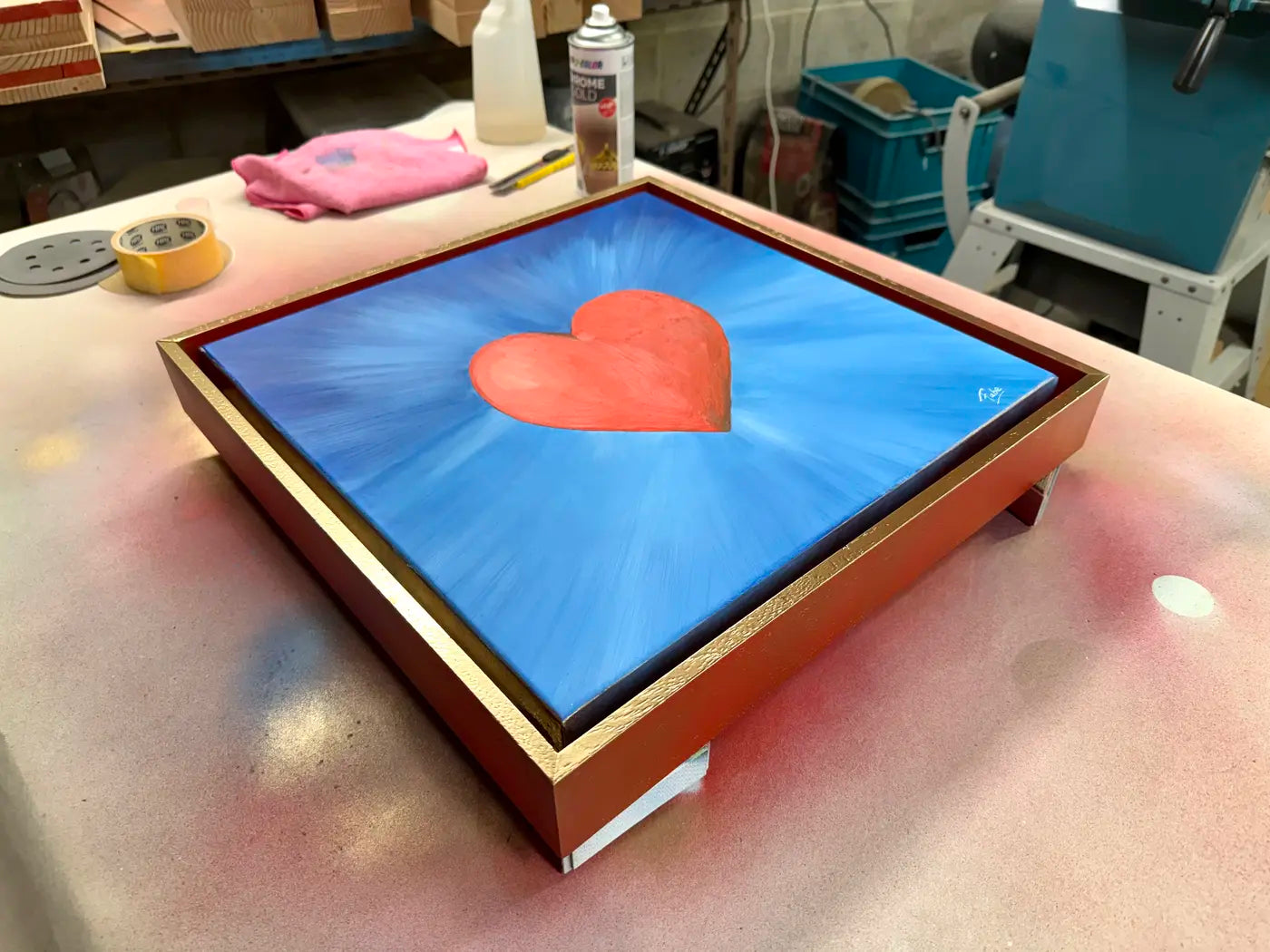
I am going to keep painting hearts that are too red, skies that are too blue, bursts of orange and yellow that don't ask anyone's permission. I am going to keep putting color back into a world that gave it up. And I am going to keep saying it as loudly as I can, to anyone who'll listen and plenty who won't: put the color back. On your walls. On your shelves. On the one wall in the room you've been too scared to touch. Let yourself feel alive again.
Less grey. On purpose.
That's not a slogan to me. It's a stance. The world went grey by default — one safe choice at a time, nobody quite deciding it, everybody going along. So color has to come back the other way. On purpose. Deliberately. Defiantly. One bright thing at a time, until the room exhales and you remember what it feels like to walk into your own life and smile.
I'll go first. I've been going first for years.
Come stand in the color with me.
— Sam
